5 Best Fishing Drones for 2026
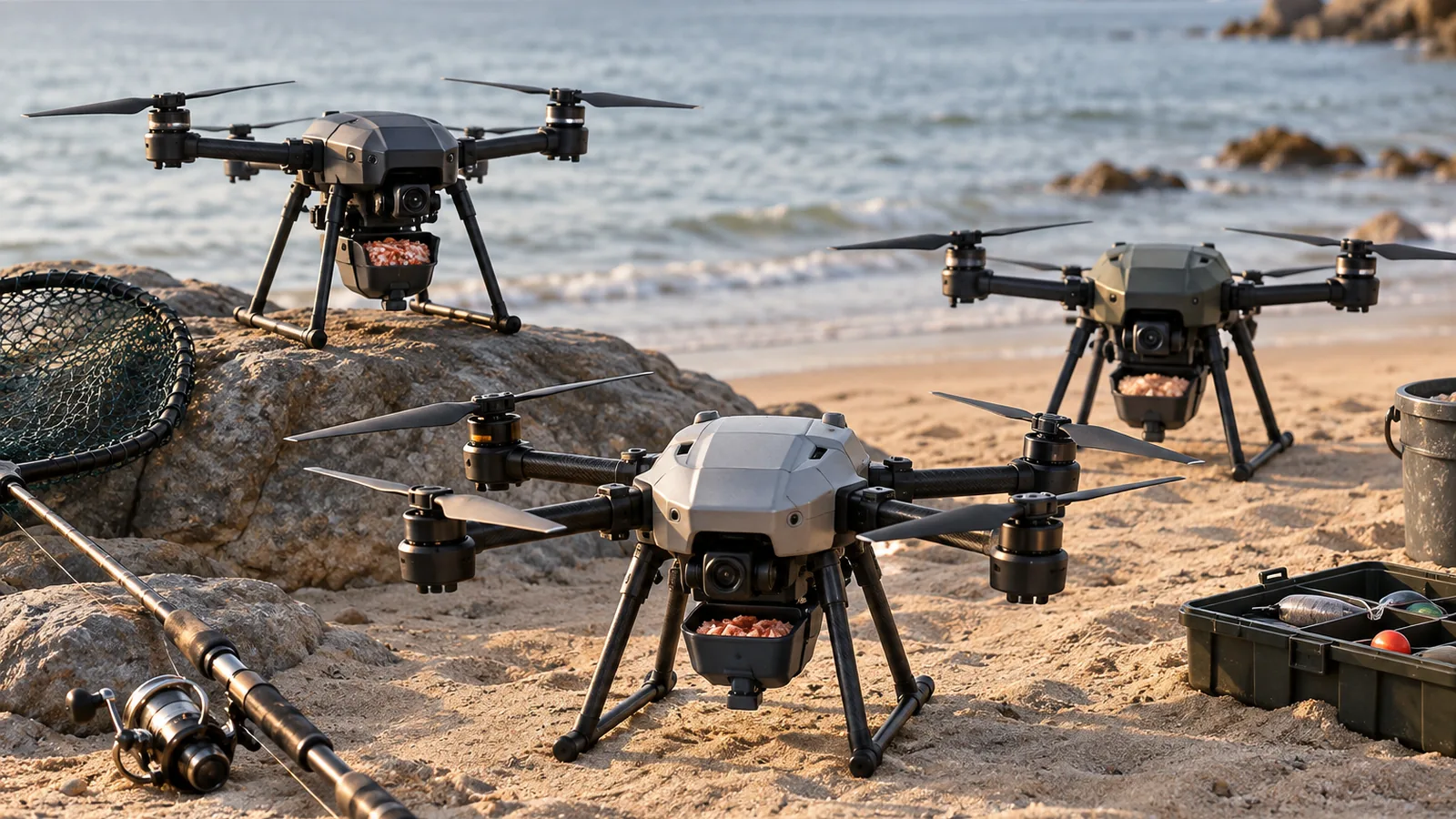
The Camoro Ideafly Fishing Drone is the Best Overall pick for anglers who prioritize payload capacity and live video. The Triblade FPV Fishing Drone suits repeated drops; the Fishing Drone Auto Drop prioritizes water protection; the Fishing Drone 4K Camera fits light bait; and the Airdrop GPS Camera Drone offers obstacle detection.
Choose based on your full bait rig’s weight, how you trigger the release, and the control and live-video ranges you need. Camera features matter too: live view helps you judge a drop, while recording saves footage.
Available owner evidence doesn’t support comparing these options for reliability, battery life, corrosion resistance, or wind performance.
The comparison table summarizes drone compatibility, payload capacity, and bait release.
Our top picks for fishing drones
- Best Overall: Camoro Ideafly Fishing Drone: shore or sea anglers seeking a purpose-built bait-delivery drone with live video
- Best for Repeated Drops: Triblade FPV Fishing Drone: shore anglers seeking an integrated bait-drop drone with live camera viewing
- Best Water Protection: Fishing Drone Auto Drop: anglers seeking an integrated bait-release drone with live camera viewing
How to Choose a Fishing Drone
Match payload capacity to your bait rig
Weigh the complete rig you plan to carry, including bait, hook, leader and any added weight. Choose a drone whose stated payload exceeds that total, rather than treating the rating as a target you should reach on every flight. A larger bait load calls for more capacity, but a listed payload rating alone doesn’t prove the drone can carry that load reliably in flight.
Keep a margin between your rig’s weight and the drone’s stated maximum. If you’ll vary bait or tackle, base your choice on the heaviest setup you expect to use.
Check how the bait-release system works
Look for a release you can operate from the controller or app, and consider how easily you can trigger it at your intended drop point. A release that requires an extra hand-held control or a separate app can add steps while you’re managing the flight.
Think through the full sequence: attach the rig, carry it to the drop point, release it and bring the drone back. Match the control method to how you plan to fish. The release mechanism’s presence alone doesn’t tell you how it behaves with your particular bait rig.
Compare stated range with your fishing distance
Start with the farthest distance you expect to fly from your launch point, then compare it with the drone’s stated control and video ranges. These are different measures: control range concerns commands to the aircraft, while video range concerns the live feed you use to see its view.
For fishing, the useful range is the one that lets you reach your drop point and maintain the control and view you need. A quoted maximum may not reflect usable range in every setting. Leave room for the return flight rather than planning to use the full stated distance.
Assess camera and live-view features
Decide whether you need a camera mainly to frame a bait drop or to record footage. A live view can help you judge where the drone is heading, while recording features matter if you want to save video for later.
Compare the camera’s stated resolution with its live-view transmission range. A high-resolution camera doesn’t, by itself, tell you how clear or responsive the view will be while you’re flying. Pick features that serve your fishing task, rather than paying attention to a resolution number alone.
Look for water protection and recovery features
Consider the risk of a splash or a landing near the water, then look for stated water protection and recovery features that fit that risk. GPS return can help guide a drone back toward its takeoff point. Flotation can help keep an aircraft at the surface after a water landing, where that feature is specified.
Treat these as separate protections: a return function addresses getting back, while flotation addresses staying on the surface. Neither makes a drone suitable for every water exposure. Water protection, GPS return and flotation solve different problems.
Treat flight time and wind claims cautiously
Plan around the flight time you can use while carrying your rig, not just a quoted maximum. Keep enough battery for the return leg, and avoid treating a headline runtime as a promise for a loaded flight.
Wind performance also matters to a bait run, since the drone needs to carry the rig out and return under the conditions you fish in. Reliability, battery life, corrosion resistance and wind performance remain unverified for comparison across the options here, so don’t rank models on those claims alone. Give more weight to the features tied directly to your fishing plan, such as payload, release control and the view you need.
| Camoro Ideafly Fishing Drone |  | Best Overall | Drone compatibility: Purpose-built fishing drone | Payload capacity: 6.6 lb | Bait release: Integrated bait-release mechanism | VIEW LATEST PRICE | Read Our Analysis |
| Triblade FPV Fishing Drone |  | Best for Repeated Drops | Drone compatibility: Purpose-built fishing drone | Payload capacity: 6.61 lb (3 kg) | Bait release: Included fishing dispenser | VIEW LATEST PRICE | Read Our Analysis |
| Fishing Drone Auto Drop |  | Best Water Protection | Drone compatibility: Complete purpose-built fishing drone | Payload capacity: 6.6 lb | Bait release: Included; release via remote or app | VIEW LATEST PRICE | Read Our Analysis |
| Fishing Drone 4K Camera | 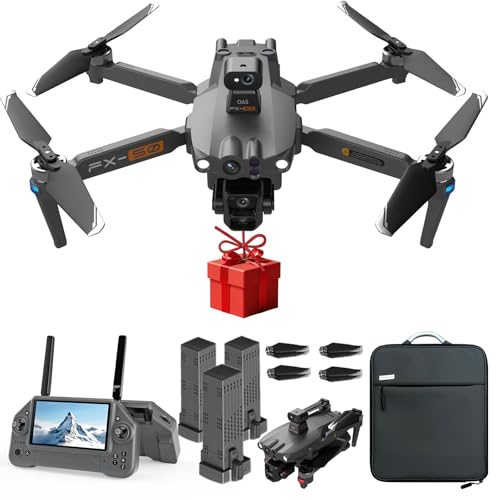 | Best for Light Bait | Drone compatibility: Complete drone with bottom hook | Payload capacity: 0.88 lb | Bait release: Bottom hook; release count unstated | VIEW LATEST PRICE | Read Our Analysis |
| Airdrop GPS Camera Drone |  | Best for Obstacle Detection | Drone compatibility: Complete drone; integrated release | Payload capacity: 1 lb | Bait release: Yes, payload airdrop | VIEW LATEST PRICE | Read Our Analysis |
More Details on Our Top Picks
Camoro Ideafly Fishing Drone
For shore or sea anglers who need bait delivered offshore, this Best Overall pick pairs a purpose-built fishing drone with live video. Camoro Ideafly Fishing Drone carries a stated 3 kg payload and uses an integrated dispenser for repeated bait drops. Its 4K camera and gimbal provide stabilized video, with live transmission claimed up to 1,000 m over 5G Wi-Fi.
GPS heading correction supports flight control, and the waterproof switch is designed to keep power on during repeated drops. That combination makes it a strong fit among the best fishing drones for anglers who value payload and camera coverage.
One review also reports that the package arrived without instructions, so setup may take extra effort.
Pros: One owner reportedly described stable flight and accurate bait drops on a shark-fishing trip · Listing states an integrated bait dispenser and 3 kg maximum payload · Listing describes GPS heading correction and a waterproof switch for repeated drops.
Cons: A review reports an owner experienced rotor failure in flight · The same review reports months without a customer-support response.
Skip it if: you fish exposed spots in strong winds and need a documented wind-resistance rating.
- Drone compatibility:Purpose-built fishing drone
- Payload capacity:6.6 lb
- Bait release:Integrated bait-release mechanism
- Flight distance:0.93 mi RC distance
- Flight time:—
- Camera:4K; single-axis gimbal
- Wind resistance:—
Triblade FPV Fishing Drone
With a stated 3 kg payload, the Triblade FPV Fishing Drone suits shore anglers making repeated bait drops. Its included dispenser handles bait delivery, and GPS heading correction supports flight control. The 4K camera sends live video over 5G Wi-Fi up to 1,000 m. Electronic anti-shake and a single-axis gimbal steady the view, and a night light supports fishing in dark conditions.
The fishing dispenser comes included, alongside an IDF-9 flight controller with GPS heading correction and compass-interference monitoring. The three-blade propellers pair with a waterproof design for fishing use. Its camera can help you see a bait release, but owners also report that the camera adds weight and may be unnecessary for some conditions. The live camera feed gives you a view of the flight and release, while the included dispenser is built for repeated drops.
Pros: Camera helps confirm trace release (2025) · Successful bait drops on a shark-fishing trip (2026 review).
Cons: Owner comments indicate the camera may be unnecessary for some fishing conditions (2025) · Camera adds weight (2025).
Skip it if: you want a bait drone without a camera, since its camera adds weight and may be unnecessary for your fishing conditions.
- Drone compatibility:Purpose-built fishing drone
- Payload capacity:6.61 lb (3 kg)
- Bait release:Included fishing dispenser
- Flight distance:—
- Flight time:28 min maximum
- Camera:4K; single-axis gimbal
- Wind resistance:—
Fishing Drone Auto Drop
For anglers seeking an integrated bait-release drone with live camera viewing, IP66 protection and a three-hour float suit water-adjacent fishing. Its 4K waterproof camera has a single-axis gimbal, and live video reaches up to 0.62 mi. GPS/GLONASS positioning and return-to-home add navigation support, while the bait release works from the remote controller or mobile app. The built-in release means you can carry and drop bait without adding a separate release mechanism to the drone.
The Camoro Fishing Drone Auto Drop is a complete purpose-built system, with two 8000 mAh 6S batteries listed in its manual. You can trigger the release from the controller or app while viewing the live feed.
Its stated payload capacity is 6.6 lb, but the shorter flight time at higher loads matters for longer runs. The drone floats for three hours, giving you time to retrieve it if it lands in the water.
Skip it if: you need extended flight time with a 5.5 lb payload.
- Drone compatibility:Complete purpose-built fishing drone
- Payload capacity:6.6 lb
- Bait release:Included; release via remote or app
- Flight distance:—
- Flight time:18 min at 2.2 lb
- Camera:4K waterproof camera; live feed
- Wind resistance:—
Fishing Drone 4K Camera
Unlike the Triblade FPV Fishing Drone, Feoffey’s model suits anglers targeting light bait who want a camera and touchscreen control.
It comes ready to fly with a carrying backpack and 16G SD card. GPS supports Return Home for low battery or signal loss, plus Follow Me. Its 400 g bait ceiling rules out heavier drops, making this setup a fit for light-bait fishing and aerial footage.
Skip it if: your bait payload regularly exceeds 400 g.
- Drone compatibility:Complete drone with bottom hook
- Payload capacity:0.88 lb
- Bait release:Bottom hook; release count unstated
- Flight distance:8 mi stated transmission range
- Flight time:120 min, 3 batteries
- Camera:4K HDR; 3-axis gimbal; 20 MP
- Wind resistance:—
Airdrop GPS Camera Drone
Shore anglers who want obstacle sensing alongside GPS return and bait release will find the Airdrop GPS Camera Drone a close fit. Its 360° obstacle detection is paired with waypoint and orbit modes, while GPS auto-return responds to low battery or lost signal. A motorized gimbal, electronic image stabilization and 50x digital zoom add camera controls for scouting or recording your fishing trip.
The foldable drone comes with two batteries, a 16 GB card, spare propellers, cables and a screwdriver. Together, the batteries provide 55 minutes total flight time. You can preview the live feed on the controller without a phone, then use one-key release to drop bait. The 1 lb payload ceiling makes it a poor match for anglers who need to carry heavier rigs; that limit is the main constraint on its bait-drop use.
Skip it if: your bait rig weighs more than the drone’s 1 lb payload limit.
- Drone compatibility:Complete drone; integrated release
- Payload capacity:1 lb
- Bait release:Yes, payload airdrop
- Flight distance:—
- Flight time:55 min total, 2 batteries
- Camera:2.7K gimbal, EIS, 50x digital zoom
- Wind resistance:—
Fishing Drones: Key Specs Side by Side
Here is how the 5 picks line up on drone compatibility, payload capacity, bait release, flight time and camera. Cells marked with a dash are specs the maker leaves out of its listing.
| Pick | Drone compatibility | Payload capacity | Bait release | Flight time | Camera |
|---|---|---|---|---|---|
| Camoro Ideafly Fishing Drone | Purpose-built fishing drone | 6.6 lb | Integrated bait-release mechanism | — | 4K; single-axis gimbal |
| Triblade FPV Fishing Drone | Purpose-built fishing drone | 6.61 lb (3 kg) | Included fishing dispenser | 28 min maximum | 4K; single-axis gimbal |
| Fishing Drone Auto Drop | Complete purpose-built fishing drone | 6.6 lb | Included; release via remote or app | 18 min at 2.2 lb | 4K waterproof camera; live feed |
| Fishing Drone 4K Camera | Complete drone with bottom hook | 0.88 lb | Bottom hook; release count unstated | 120 min, 3 batteries | 4K HDR; 3-axis gimbal; 20 MP |
| Airdrop GPS Camera Drone | Complete drone; integrated release | 1 lb | Yes, payload airdrop | 55 min total, 2 batteries | 2.7K gimbal, EIS, 50x digital zoom |
Frequently Asked Questions
Can I use a regular camera drone for drone fishing?
Yes, if it can carry your complete bait rig and has a release method you can control during flight. A camera drone’s stated payload alone doesn’t show how it will perform under load, so leave capacity for a margin and plan for the return flight.
Are drone fishing and bait drops legal where I fish?
Rules depend on where you fish, so check local rules for drone use, bait drops and fishing before flying. Follow any applicable limits on where drones may fly and where fishing is allowed; legality can vary by location.
Can a fishing drone help me spot fish?
A live camera feed can show the view from the drone, but camera resolution alone doesn’t establish how clearly you’ll see fish. For example, the Camoro Ideafly Fishing Drone lists a 4K camera, gimbal and live transmission up to 1,000 m.
Which fishing drone is best for beginners?
Choose a model with a release you can operate from its controller or app, plus a live view that helps you judge the drop point. The Fishing Drone Auto Drop has a controller- or app-operated release, GPS/GLONASS positioning and return-to-home functions.
Do I need a waterproof fishing drone for saltwater?
A water-resistant design can help if spray or a water landing is a concern, but waterproofing doesn’t establish saltwater durability. Treat water protection, flotation and GPS return as separate features, and keep your bait rig below the drone’s stated payload.
Conclusion
Choose by the heaviest rig you plan to fly and the view you need: pick the Fishing Drone 4K Camera for light bait and a stabilized camera, or a purpose-built model when your rig needs more capacity. For repeated drops, prioritize an integrated dispenser; for fishing near water, weigh flotation and water protection alongside payload. Match the drone to your full rig, not just the bait’s weight. Next, weigh your complete setup and compare it with the relevant model’s stated payload and release method.
Sources
- Best Drone for Fishing 2026: Waterproof Payload-Release Picks Ranked (dronegearhq.com)
- Best Fishing Drones in 2026 for Bait Dropping and Payload | BestDroneFor (bestdronefor.com)
- 7 Best Fishing Drones with Bait Release Systems (October 2026) Quality Reviews (pwice.com)
- Best drone for fishing (2026): filming, scouting and the rules – Uplink Imaging (uplinkimaging.com)
- How to Choose a Fishing Drone | Scanixx – Scanixx LLC (scanixx.com)