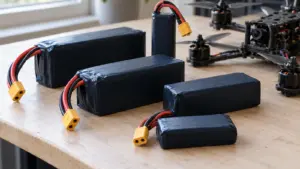
LiPo Battery C Rating Explained: How to Choose

A LiPo battery C-rating tells you its stated discharge current relative to capacity: multiply capacity in amp-hours by the C-rating to get the label-implied current. That current is theoretical, not a guarantee the pack can deliver it in flight, so compare your drone’s demand with the battery’s continuous rating rather than relying on its burst rating.
What does a LiPo battery C-rating mean, and how do I choose one?
Quick answer: A C-rating states how much discharge current a battery claims relative to its capacity: multiply capacity in amp-hours by the C-rating to calculate its theoretical current in amps. For example, a 1.3 Ah, 100C pack implies 130 A, but that calculation doesn’t prove the battery can deliver that current in practice. Estimate your drone’s total demand, divide amps by capacity in amp-hours, and compare the result with the pack’s continuous rating; use the burst rating only for short-duration demand. Check current under a representative load, since printed ratings don’t guarantee real-world performance and higher-C packs can add weight and cost.
- Convert capacity from mAh to Ah by dividing by 1,000.
- Add expected current from all motors and other onboard loads.
- Divide total demand in amps by battery capacity in Ah to calculate the required C-rating.
- Compare that result with the pack’s continuous C-rating, not its burst rating, for sustained demand.
- Use a current sensor, OSD, or representative load test to check real-world performance
How do you read continuous and burst ratings?
When a pack lists both ratings, use its continuous rating to judge sustained current demand; the burst rating applies only to short-duration discharge. A C-rating describes stated discharge current relative to battery capacity, so the continuous and burst figures refer to different discharge conditions.
Burst discharge is normally described as lasting within 10 seconds, making that rating a poor basis for judging demand that continues longer. A pack may list a higher burst rating than continuous rating, but that higher figure is for short bursts, not sustained use.
Read the label this way:
- Continuous C-rating: the pack’s stated rating for sustained discharge.
- Burst C-rating: the pack’s stated rating for short-duration discharge.
How much C-rating does your drone need?
Estimate your drone’s needed C-rating by adding its expected current draw, then dividing that total by battery capacity in amp-hours; compare the result with the pack’s continuous rating. This gives you a starting point for choosing a battery, not a guarantee that it will deliver the calculated current in flight.
Start with motor-and-prop data or measured current for the setup you plan to fly. Add the expected draw of all motors, then account for other onboard loads so your estimate reflects the full system demand. For example, at 36.74 A per motor, four motors would draw 146.96 A combined. Use the current figures for your specific motor-and-prop combination, since changing that setup changes the estimate.
Once you have a total current estimate, divide it in amps by the battery’s capacity in amp-hours. For an 80 A demand and a 1.3 Ah pack, the calculation gives about 62C. Compare that result with the battery’s continuous rating, since sustained demand is the relevant figure for a drone drawing power over the flight.
Treat static-thrust current as a conservative reference, rather than assuming the drone will draw that much throughout a flight. Actual in-flight current can be lower than the current measured at static thrust. If your estimate comes from motor data rather than measurements on your own setup, leave room for other onboard loads in the total before calculating the required rating. The point of the calculation is to check whether the pack’s continuous capability can meet your estimated demand, not to treat the label-implied current as a promise of real-world performance.
Why can real-world performance differ?
Voltage sag, battery condition, and test conditions can make a LiPo deliver less power than its printed C-rating suggests. Internal resistance causes voltage to drop under load; lower voltage can reduce motor RPM and make your drone feel less powerful and responsive.
A printed C-rating is a label, not a reliable way to compare brands. In a comparison around 70–75 A, packs labeled 45C, 65C, and 50C did not show the highest label-implied current producing the least voltage sag. Use the label as a starting point, then judge packs by how they perform under the demand your drone actually sees.
Battery age and use can change performance, as can over-discharge, excessive current, overheating, and cold. A current sensor or on-screen display (OSD) can help you see the load during flight, while a controlled test under a real load can show how the pack responds. Keep the test relevant: a 12 A test may not represent the 80–100 A punch-outs a typical 5-inch drone may draw.
Higher-C packs may suit power-hungry builds, but they can add weight and cost, so match the pack to measured demand. A low-power cruiser may gain little from carrying a heavier, more expensive pack if its current demand is modest.
Quick reference for C-rating calculations
Use capacity in amp-hours and multiply by C-rating to estimate label-implied current; divide demand in amps by capacity to find the required C-rating.
| Calculation | Inputs | Result |
|---|---|---|
| Convert capacity | 1,300 mAh ÷ 1,000 | 1.3 Ah |
| Theoretical current | 1.3 Ah × 100C | 130 A |
| Required C-rating | 80 A ÷ 1.3 Ah | About 62C |
For a real drone, compare the calculated requirement with the pack’s continuous discharge capability.
Frequently Asked Questions
Does a higher C-rating make a drone fly faster or improve throttle response?
No, a higher C-rating alone doesn’t make a drone faster or more responsive; it only indicates greater stated discharge current relative to capacity. If a pack’s actual power delivery reduces voltage sag under load, your motors can hold RPM better, but the label by itself doesn’t guarantee that result.
Can a LiPo battery have too high a C-rating for my drone?
No, a higher C-rating doesn’t inherently make a pack unsuitable, but it can add weight and cost without helping a low-demand build. Match the pack to measured current demand and consider whether its added discharge capability is worth carrying.
How does C-rating affect flight time?
C-rating describes stated discharge current relative to capacity; it doesn’t directly specify how long a battery will fly. A higher-C pack may add weight, which can reduce its practical value on a low-power cruiser.
How can I test whether a drone battery’s C-rating is adequate?
Measure current during flight with a current sensor or OSD, then compare sustained demand with the pack’s continuous capability. A controlled load test can reveal voltage sag, but match the test to your drone’s real demand because a low-current test may not reflect hard throttle use.
What happens if a LiPo battery’s C-rating is too low?
A pack that can’t meet the drone’s demand may sag in voltage under load, reducing motor RPM and making the drone feel less powerful and responsive. Check real current draw and the pack’s continuous rating, since the printed C-rating alone doesn’t guarantee its actual output.
Conclusion
If your drone’s estimated sustained demand approaches the pack’s continuous capability, choose a pack with more headroom; if demand is modest, avoid carrying extra weight and cost for a higher rating you don’t need. Next, add the expected draw from your full setup, compare it with the pack’s continuous rating, then check current during flight or under a representative load. Treat the label as a screening tool, and use the real-load check to decide whether the pack suits your build.
Sources
- Using LiPo Batteries for FPV Drones: Beginner's Guide with Top Product Recommendations (oscarliang.com, 2025-03-02T00:00:06+00:00)
- oscarliang.com (oscarliang.com)